Dispatches from the Future: What It Costs to Make Work Nobody's Ready For Yet
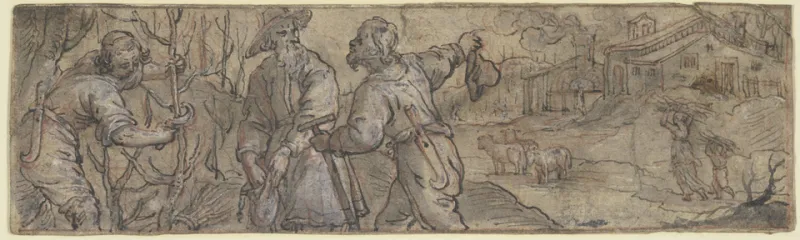
Photo: Jacopo Bassano, PDM-owner, via Wikimedia Commons
There's a moment that a lot of artists know but rarely talk about out loud. You finish something — a painting, a record, a film, a manuscript — and you feel it hum with whatever truth you were trying to catch. And then you send it out into the world, and the world just… doesn't quite hear it. Not with hostility. Not with cruelty. Just with a kind of polite, distracted confusion, like you've walked into a party speaking a language everyone almost understands.
That almost is where it gets complicated.
Because being misunderstood is one thing. Being early is something else entirely.
The Difference Between Rejected and Premature
Rejection has a particular texture. It's sharp. It tells you something — even if what it tells you is wrong, even if it's more about the taste of whoever's holding the door than about the quality of your work. But premature reception is murkier. The work doesn't get torn apart. It just gets set aside, quietly, like a book someone means to return to when they have more time.
Nick Drake released Pink Moon in 1972 to almost complete commercial silence. He pressed fewer than 5,000 copies. He died two years later, twenty-six years old, having never seen the album connect with anyone in any meaningful way. Then Volkswagen licensed one of its songs for a commercial in 1999, and suddenly an entire generation discovered him at once — not because the music had changed, but because the world had finally caught up to the emotional register he was operating in.
That's not a redemption story. Or rather, it's only a redemption story for us. For Drake, it was just a life lived in the wrong moment.
The question isn't whether history will vindicate you. The question is what you do with yourself while you're waiting to find out.
What It Actually Feels Like
Most artists don't walk around thinking I am ahead of my time — that framing sounds too self-congratulatory, too easy. What it actually feels like, day to day, is more like a persistent low-grade disorientation. You make the thing that feels most true to you. You share it. And then you watch as the conversation moves around it, not through it.
The temptation — and it's a real one — is to decide you've misjudged the work. To smooth it out, sand down the edges, make it a little more legible to the current moment. Some artists do this, and sometimes it even works. But there's a cost to that kind of translation. You can lose the original frequency in the process.
Arthur Russell spent most of the seventies and eighties making music that defied every category available to him at the time — too weird for pop, too melodic for the avant-garde, too danceable for the downtown art crowd, too strange for the dance floors. He worked obsessively, recorded constantly, and released almost nothing in his lifetime. He died in 1992. In the 2000s, archivists started piecing together what he'd left behind, and suddenly he was everywhere — cited by musicians across every genre, beloved by people who'd been born after he died. His audience had arrived. He just wasn't around to meet them.
That's the real weight of being early. Not obscurity — obscurity can be peaceful, even productive. It's the suspicion that the connection you're making is real, just... displaced in time.
The Psychological Work of Staying in the Room
So how do you keep going? How do you sustain a practice when the feedback loop is broken, when the signal you're putting out isn't bouncing back from anywhere?
One answer — maybe the most honest one — is that you have to detach the making from the receiving. Easier said than done, obviously. But there's something to the idea that the work itself has to be enough to justify its own existence, at least in the short term. Not because external validation doesn't matter (it does, it's human, you're allowed to want it), but because tying your continued output to the current market's ability to receive it is a kind of creative hostage situation.
Another answer is community — not audience, but community. Finding the two or three or ten people who do hear what you're doing, even if they're not the crowd you imagined, even if they're just other artists working in the same strange frequency. Misfit solidarity is a real thing. It doesn't pay rent, but it keeps you sane.
And then there's documentation. Keeping records of the work, the thinking behind it, the moment of its creation. Not for posterity in some grand sense — just because if the conversation you're having is with the future, it helps to leave clear notes. Van Gogh wrote letters. Drake recorded demo after demo. Russell left behind cassettes that no one catalogued for decades. The work survived because they kept making it, kept archiving it, kept treating it as if it mattered even when the present moment refused to confirm that.
Being Early Isn't the Same as Being Right
Here's the part that's uncomfortable to say: not every artist who goes unrecognized in their time is a misunderstood genius. Some work is genuinely not good. Some work is ahead of its time; some work is just out of step. The difference is hard to see from the inside, which is part of what makes the whole situation so psychologically complex.
You can't know, with any certainty, whether you're Nick Drake or whether you're someone who made something earnest and strange that just didn't quite work. Both experiences feel identical from the inside. The loneliness is the same. The silence is the same.
What that means, practically, is that the only move available to you is to keep refining your own judgment. To stay honest with yourself about the work — not defensive, not falsely modest, but genuinely curious. To keep asking whether the problem is the world's readiness or your own execution. To hold both possibilities at once without letting either one paralyze you.
The Conversation That Spans Decades
There's a version of artistic practice that isn't really about any single moment of reception. It's more like a long letter — written now, delivered later, read by someone you'll never meet in a context you can't quite imagine.
That's a strange thing to build your life around. It requires a particular kind of faith that isn't religious, exactly, but isn't entirely rational either. It's more like a bet — a bet that the feeling you're chasing is real, that the frequency you're transmitting on exists, that somewhere out there is a room full of people who will one day put on your record or stand in front of your painting or read your pages and feel exactly what you were trying to say.
You just might not be alive to see it.
Most artists aren't working with that kind of timeline in mind. Most of us want connection now, want the feedback loop to close, want to know the work landed somewhere soft. That's not weakness. That's just being human.
But if you're making work that feels ahead of the moment — if you're operating in a register that the present can't quite tune into — maybe the most useful thing you can do is make peace with the displacement. Not accept it as permanent. Not stop hoping. Just stop letting it be the thing that breaks you.
The future is already listening. It's just doing it quietly, from somewhere you can't see yet.